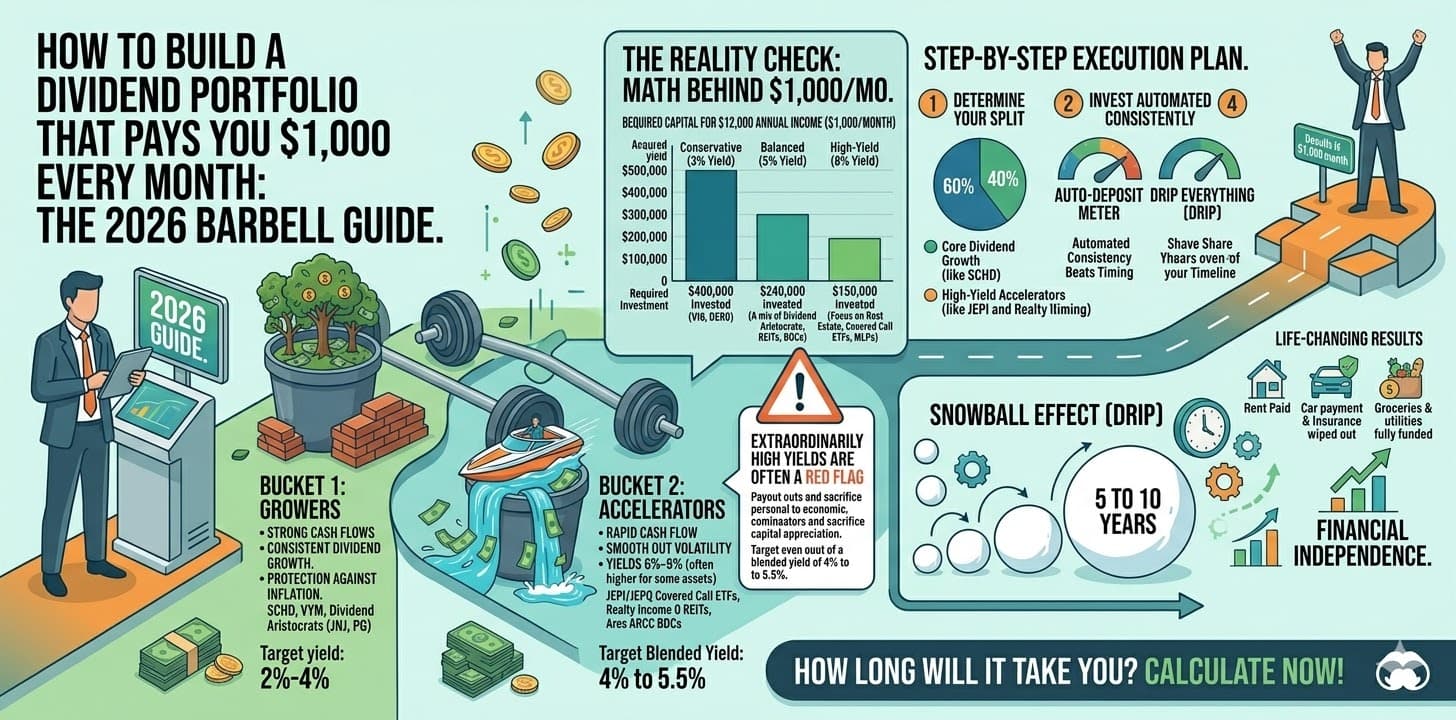
Building a portfolio that pays you $1,000 every single month is one of the most exciting financial milestones an investor can reach. It's the point where your passive income becomes tangibly life-changing, enough to cover rent in some cities, completely wipe out a car payment and insurance, or fully fund your groceries and utilities.
But how do you actually get there in 2026? Between shifting interest rates, evolving ETF landscapes, and market volatility, building a sustainable income stream requires more than just chasing the highest yields.
In this guide, we will break down the exact math needed to reach $1,000 a month ($12,000 a year), outline a modern "barbell" strategy using reliable dividend growth stocks and high-yield ETFs, and show you how to accelerate your timeline.
The Reality Check: The Math Behind $1,000 a Month
Before picking stocks or ETFs, it is crucial to understand the mathematical reality of your goal. Earning $1,000 a month equates to $12,000 in annual dividend income. The amount of capital you need to generate this income depends entirely on the dividend yield of your portfolio.
Here is what the required capital looks like across different average portfolio yields:
- Conservative (3% Yield): $400,000 invested (Focus on broad market funds like VIG or DGRO)
- Balanced (5% Yield): $240,000 invested (A mix of Dividend Aristocrats, REITs, and BDCs)
- High-Yield (8% Yield): $150,000 invested (Focus on Real Estate, Covered Call ETFs, and MLPs)
Many new investors are tempted to simply throw $150,000 into a risky 8% yielder to hit the finish line faster. However, extraordinarily high yields are often a red flag for companies about to cut their payouts, or funds that sacrifice all capital appreciation for income. This is why modern dividend investors usually target a blended yield of 4% to 5.5%.
The 2026 "Barbell" Strategy: Balancing Growth and Income
To hit the $1,000/month milestone without risking the erosion of your principal, consider the "Barbell Strategy." This involves placing your capital into two distinct buckets: Dividend Growers and High-Yield Income Generators.
Bucket 1: The Dividend Growers (The Foundation)
These are investments with a modest starting yield (2% - 4%) but a phenomenal history of raising their payouts every year. Your goal here is to protect your purchasing power against inflation.
- Schwab U.S. Dividend Equity ETF (SCHD): The quintessential dividend growth ETF. It meticulously tracks companies with strong cash flows and consistent dividend growth.
- Vanguard High Dividend Yield ETF (VYM): Covers a broad spectrum of large-cap U.S. stocks, offering excellent defensive properties and reliable growth.
- Dividend Aristocrats: Single stocks like Johnson & Johnson (JNJ) or Procter & Gamble (PG) that have raised payouts for over 50 consecutive years.
Bucket 2: High-Yield Cash Flow (The Accelerators)
To pull your average portfolio yield up to that sweet spot of 5%, you need immediate cash flow. This is where you allocate capital to specialized, high-yield assets.
- Covered Call ETFs (JEPI / JEPQ): These funds generate income by selling call options on their underlying portfolios. They are incredibly popular in 2026 for smoothing out volatility while offering yields often between 6% to 9%.
- Real Estate Investment Trusts (REITs): Companies like Realty Income (O), which literally bills itself as "The Monthly Dividend Company", distribute 90% of their taxable income to shareholders, frequently yielding 5% or more.
- Business Development Companies (BDCs): Firms like Ares Capital (ARCC) that finance private, mid-sized companies. They often carry yields of around 8% to 10%.
The Power of the Snowball Effect (DRIP)
If looking at entirely funding a $240,000 portfolio feels daunting, remember that you don’t have to contribute all that money out of your own pocket.
By activating a Dividend Reinvestment Plan (DRIP), every dividend payment you receive from your stocks is automatically used to buy fractional shares of those same stocks. This increases your share count, which in turn increases your next dividend payment. Over a span of 5 to 10 years, this compounding "snowball effect" can shave years off the time it takes to hit your $1,000/month goal.
If you want the deeper mechanics behind that process, our article on dividend reinvestment breaks down exactly why DRIPs matter.
Step-by-Step Execution Plan
Want to start today? Here is your exact blueprint:
- Fund a Brokerage Account: Make sure you are utilizing tax-advantaged accounts like a Roth IRA where possible, as standard dividend payments are taxable. If you are still choosing where to invest, our roundup of the top investment brokers can help narrow down the platform options.
- Determine Your Split: A popular modern split is 60% Core Dividend Growth (like SCHD) and 40% High-Yield Accelerators (like JEPI and Realty Income). If you want more ETF candidates for the core sleeve, start with our guide to the top dividend ETFs.
- Invest Consistently: Set up auto-deposits. Whether it's $100 or $1,000 a month, consistency beats timing the market.
- Reinvest Everything: Keep DRIP turned on until you officially cross the $1,000 a month threshold. Only then should you start diverting the cash to pay for your actual expenses.
How Long Will It Take You?
The journey to $1,000 a month in dividends is a marathon, not a sprint. Your timeline depends heavily on two factors: how much you start with and how much you contribute monthly.
Stop guessing and find out exactly what it will take to hit your goal. Our proprietary Dividend Calculator lets you plug in your starting principal, your target yield, and your monthly contributions to chart your precise path to financial independence.
Disclaimer: This blog post is for informational and educational purposes only and should not be construed as financial, investment, or tax advice. The financial markets involve risk, and past performance is not indicative of future results. Always conduct your own thorough research and consult with a qualified financial advisor or tax professional before making any investment decisions. The tools and information provided are not a substitute for professional advice tailored to your individual circumstances.
More ETF Comparisons
Explore other side-by-side ETF comparisons popular with dividend investors.