Introduction
The allure of dividend investing is timeless: getting paid simply for owning a slice of corporate America (and the world). In an era of market volatility, dividend-paying stocks offer a psychological anchor and a tangible return on investment regardless of daily price swings.
However, picking individual dividend stocks requires immense research to avoid "yield traps"—companies with unsustainably high payouts about to be cut.
If you are still learning how to separate real income opportunities from traps, our guide to high-yield dividend stocks explains the warning signs in more detail.
This is where Exchange-Traded Funds (ETFs) shine. They offer instant diversification, professional methodology, and extreme tax efficiency. But not all dividend ETFs are created equal. Some chase the highest possible yield right now, while others focus on companies that grow their payouts over decades.
That built-in diversification is especially useful if you are trying to avoid over-concentrating a dividend portfolio in just a few sectors.
We have analyzed the market to bring you the top 10 dividend ETFs, categorized by what they do best, to help you decide which belongs in your portfolio.
Use the interactive stock quote cards below to see real-time data for the ETFs discussed in this guide. Each quote updates with current price, yield, and key metrics.
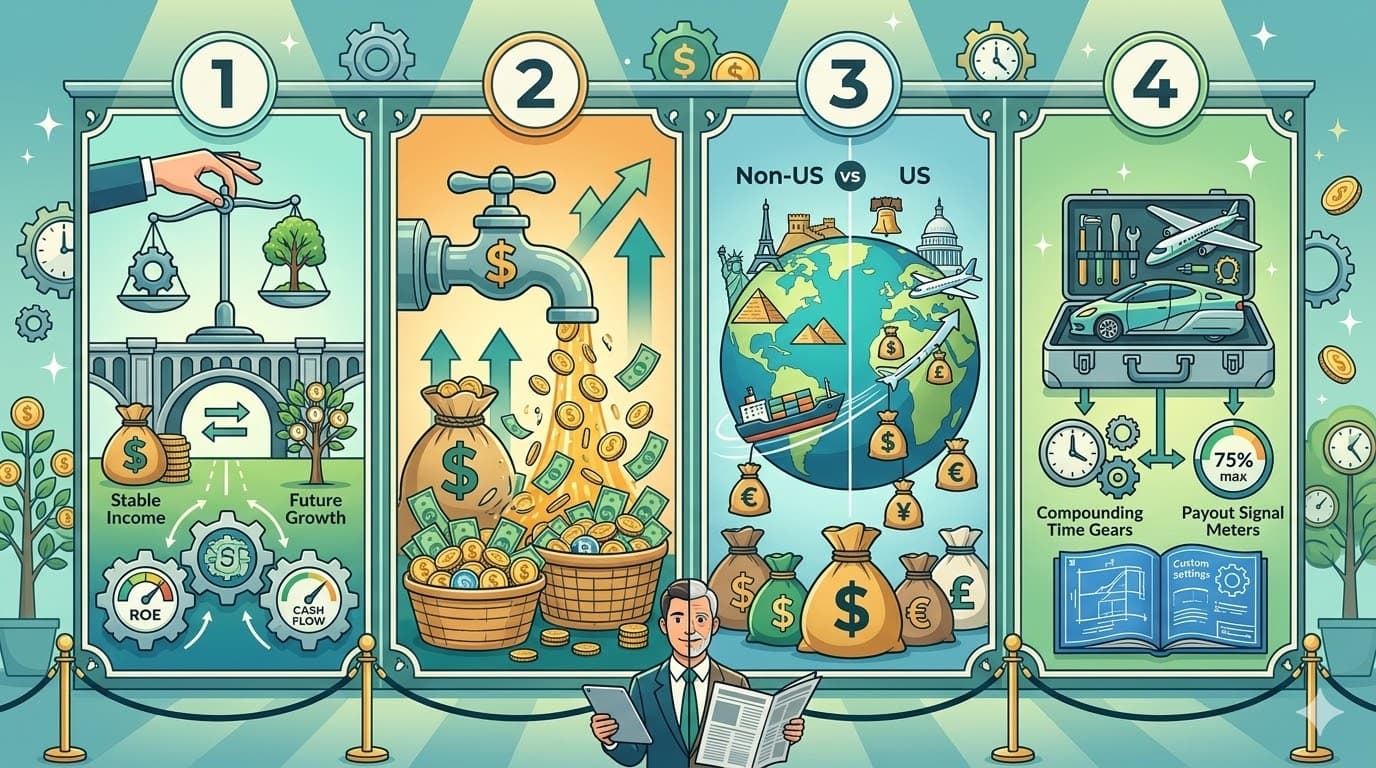
Category 1: The "Big Three" (Stability & Growth Balance)
These are the foundational holdings for most dividend investors. They possess massive assets under management (AUM), rock-bottom expense ratios, and proven methodologies that balance current income with future growth.
1. SCHD - Schwab U.S. Dividend Equity ETF
The Strategy: SCHD is often considered the gold standard for dividend investors because of its rigorous screening process. It tracks the Dow Jones U.S. Dividend 100 Index, focusing on companies with a 10-year history of paying dividends. Crucially, it screens for fundamental strength using metrics like return on equity (ROE) and cash flow to total debt.
The Benefits: SCHD is often called the "Goldilocks" ETF. It offers a respectable current yield (usually higher than the S&P 500 average) combined with impressive capital appreciation and dividend growth rate. It holds powerhouse companies like Broadcom, Merck, and PepsiCo.
The Drawbacks: Its strict screening means it is highly selective. It often has zero exposure to major sectors that don't typically pay high dividends, such as big tech or certain communications stocks, leading to periods where it may trail the broader market during tech booms.
2. VYM - Vanguard High Dividend Yield ETF
The Strategy: VYM casts a very wide net. It tracks the FTSE High Dividend Yield Index, which focuses on stocks forecasted to have above-average yields. Unlike SCHD's concentrated 100 holdings, VYM holds over 400 stocks.
The Benefits: Diversification is the main selling point here. If you want broad exposure to the high-yield segment of the US economy—heavily weighted toward financials, consumer staples, and industrials—this is the easiest way to get it at an incredibly low cost.
The Drawbacks: By holding 400+ companies, you are inevitably holding some mediocre performers alongside the winners. This "diworsification" means its long-term price appreciation and dividend growth rate usually lag behind more focused funds like SCHD or VIG.
3. VIG - Vanguard Dividend Appreciation ETF
The Strategy: VIG is not about high yield today; it's about high yield tomorrow. It tracks the S&P U.S. Dividend Growers Index, which requires companies to have increased their dividends for at least 10 consecutive years. It also eliminates the highest yielders to avoid distressed companies.
The Benefits: This is a quality filter. Companies that can raise dividends for a decade through recessions and booms are usually financially fortress-like. VIG holds growth-oriented names like Microsoft and Visa that you won't find in high-yield funds. Over long periods, VIG often offers the best total return (price growth + dividends) of this group.
The Drawbacks: The starting yield is low (often below 2%). Investors needing immediate, significant income to live on will find VIG insufficient. It requires patience to let the compounding work.
Category 2: High Current Income (Highest Payouts)
These ETFs prioritize maximum immediate yield. They are often favored by retirees using their portfolios for living expenses. However, higher yield often comes with slower stock price growth and higher risk.
4. SPYD - SPDR Portfolio S&P 500 High Dividend ETF
The Strategy: SPYD has a simple methodology: it takes the top 80 highest-yielding companies within the S&P 500 and weights them equally (roughly 1.25% each at rebalancing).
The Benefits: This tends to offer one of the highest yields available in a standard equity ETF. It provides heavy exposure to defensive, high-income sectors like Real Estate (REITs) and Utilities, which can perform well when interest rates stabilize.
The Drawbacks: This is the highest-risk fund on this list. A stock often has a very high yield because its share price has crashed due to underlying problems. SPYD can become a collection of these distressed companies. Its equal-weighting methodology also means smaller, riskier companies have the same impact on the fund as giant, stable ones.
5. DVY - iShares Select Dividend ETF
The Strategy: DVY has been around since 2003. It tracks roughly 100 US stocks with at least a 5-year history of dividend payments. It screens companies to ensure their earnings per share cover their dividend payouts, adding a layer of safety.
The Benefits: DVY is a middle ground between the quality focus of SCHD and the pure yield chasing of SPYD. It offers significant exposure to utilities and financial institutions that have proven reliable over a medium timeframe.
The Drawbacks: It carries a significantly higher expense ratio than its Vanguard or Schwab competitors. Furthermore, its historical total return has lagged significantly behind the broader market over the last decade.
6. FDVV - Fidelity High Dividend ETF
The Strategy: FDVV uses a proprietary methodology designed to find high current income with the potential for capital appreciation. It uses a composite score based on dividend yield, payout ratio, and dividend growth.
The Benefits: FDVV is unique in the high-yield space because it doesn't shy away from technology stocks. While many high-yield funds are stuck in slow-growing old-economy sectors, FDVV manages to capture yield while holding names like Apple and Microsoft. It has performed very well in recent years.
The Drawbacks: It has a shorter track record than the stalwarts like VYM. Its methodology is slightly more active and complex than a simple index-tracking fund, meaning you are relying more on Fidelity's screening criteria continuing to work.
Category 3: International Exposure (Global Diversification)
Many international markets have a stronger dividend culture than the US. These ETFs allow you to capture yields from Europe, Asia, and beyond.
If you want the broader case for going outside the US, see our full guide to international dividend investing.
7. VYMI - Vanguard International High Dividend Yield ETF
The Strategy: Think of this as the international version of VYM. It tracks an index of over 1,300 dividend-paying stocks in both developed and emerging markets outside the US.
The Benefits: Massive global diversification. International stocks often trade at lower valuations and higher dividend yields than US stocks, offering a potential value play. It's an easy way to ensure your income stream isn't entirely reliant on the US dollar.
The Drawbacks: International investing introduces currency risk (if the dollar gets stronger, your international returns drop) and geopolitical risk. The inclusion of emerging markets can lead to higher volatility.
8. SCHY - Schwab International Dividend Equity ETF
The Strategy: The international sibling to SCHD. It applies similar strict quality screens (ROE, cash flow, consistent payout history) to a universe of non-US stocks.
The Benefits: It attempts to solve the problem of "junk" high-yield international stocks by filtering for quality. It focuses on stable, blue-chip international firms like Unilever, Novartis, and Nestlé.
The Drawbacks: It is a relatively new fund with a limited track record. Like SCHD, its strict screens mean it is more concentrated (fewer holdings) than its Vanguard counterpart, VYMI.
9. VIGI - Vanguard International Dividend Appreciation ETF
The Strategy: The international sibling to VIG. It focuses on non-US companies with a history of increasing their dividends for at least seven consecutive years.
The Benefits: This is the best vehicle for long-term international growth. It avoids stagnant, state-owned enterprises often found in high-yield international funds and focuses on the best global dividend growers.
The Drawbacks: Similar to VIG, the starting yield is quite low. This is a long-term compounding play, not an immediate income generator.
Category 4: Special Strategy / Income Target
10. DGRO - iShares Core Dividend Growth ETF
The Strategy: DGRO occupies a unique space. It requires five years of dividend growth, but critically, it screens out stocks with payout ratios over 75%. This ensures companies are reinvesting enough cash to keep growing.
The Benefits: DGRO is often viewed as the perfect hybrid. Because it only requires a 5-year history (vs. VIG's 10 years), it catches faster-growing tech and healthcare companies earlier in their dividend-paying lifecycle. It offers a slightly higher yield than VIG with similar growth prospects.
The Drawbacks: The yield is still moderate compared to the "High Income" category. It won't satisfy investors looking for 4%+ yields immediately.
Conclusion
There is no single "best" dividend ETF. The right choice depends entirely on your financial horizon.
If you are 30 years from retirement, focus on dividend growth ETFs like VIG, DGRO, or the balanced approach of SCHD. If you are already retired and need to pay bills with your portfolio income, look toward higher yielders like VYM or potentially SPYD (in moderation).
By understanding the strategy beneath the ticker symbol, you can build a resilient income portfolio tailored exactly to your needs.
Disclaimer: This blog post is for informational and educational purposes only and should not be construed as financial, investment, or tax advice. The financial markets involve risk, and past performance is not indicative of future results. Always conduct your own thorough research and consult with a qualified financial advisor or tax professional before making any investment decisions. The tools and information provided are not a substitute for professional advice tailored to your individual circumstances.
More ETF Comparisons
Explore other side-by-side ETF comparisons popular with dividend investors.