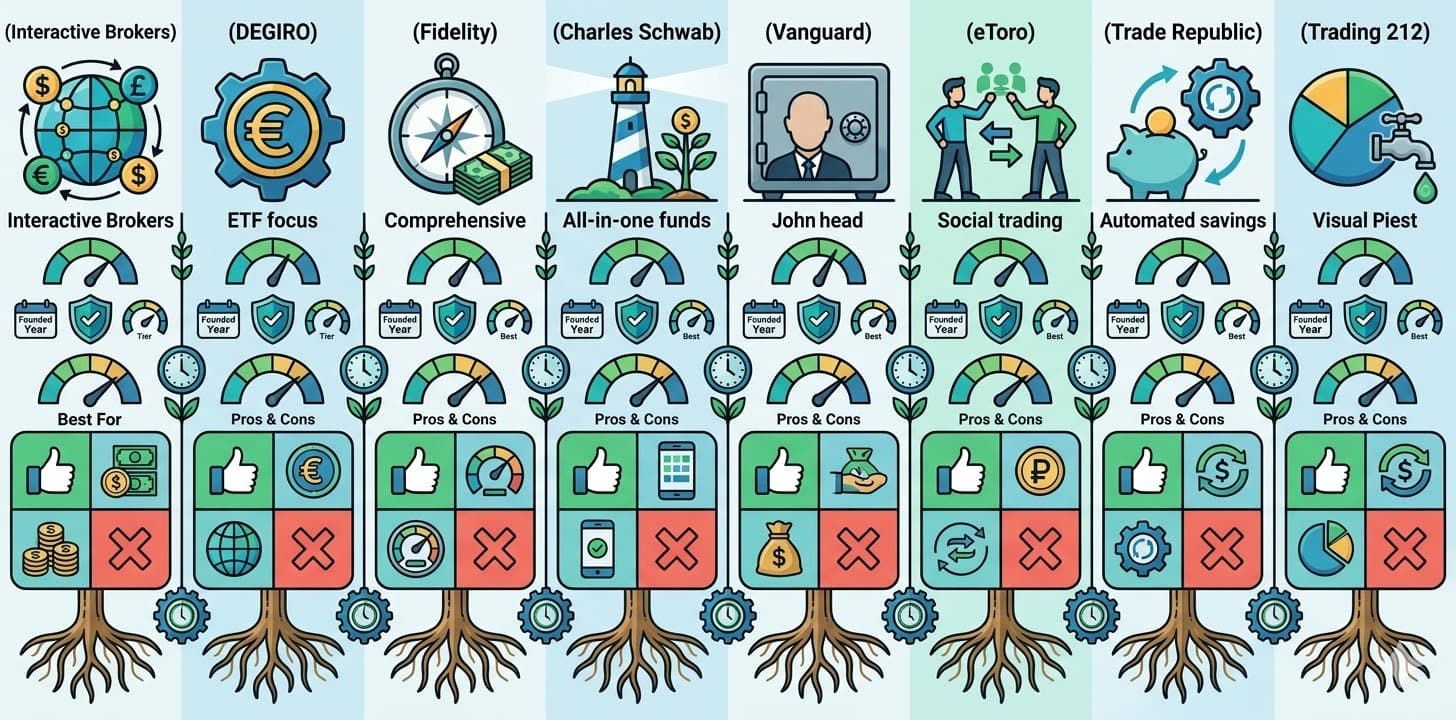
Choosing the right investment broker is one of the most consequential decisions you'll make in your wealth-building journey. As a dividend investor, you need a reliable partner with low fees, robust dividend reinvestment plans (DRIP), and access to global markets.
We've evaluated the top brokerage platforms worldwide. Our ranking methodology focuses on five key pillars:
- Regulation & Trust: Supervision by tier-1 authorities (SEC, FCA, BaFin).
- Age & Track Record: Years of stable, secure operations.
- Fee Structure: Low commissions, tight spreads, and zero hidden inactivity fees.
- Platform Usability: Intuitive desktop and mobile experiences.
- Asset Selection: Broad access to domestic and international dividend-paying stocks and ETFs.
Because broker pricing and product availability vary by country, account type, and asset class, the details below focus on the current mainstream retail offering as of March 2026.
Here are the top 8 investment brokers for dividend investors today.
1. Interactive Brokers (Our Top global Pick)
Interactive Brokers (IBKR) stands as the undisputed king of global market access. Founded in 1978, it is a publicly traded powerhouse (NASDAQ: IBKR) known for serving both retail and institutional investors.
For dividend investors, IBKR offers unparalleled access to international markets, allowing you to buy high-quality dividend stocks from Europe, Asia, and the Americas through one of the broadest global brokerage networks available.
Key Metrics
- Founded: 1978
- Primary Regulators: SEC, FINRA, FCA, and other local regulators
- Best For: Advanced traders, international investors, and margin users.
Pros & Cons
2. DEGIRO (Top Pick for Europe)
If you are based in Europe, DEGIRO is likely your best option for low-cost, straightforward dividend investing. Founded in 2008, it now operates via flatexDEGIRO Bank Dutch Branch, with primary supervision by BaFin and Dutch oversight by the AFM and DNB.
DEGIRO is renowned for its "Core Selection" of ETFs, which allows commission-free trades on selected ETFs under its published policy. That makes it especially attractive for long-term ETF accumulators who want to keep direct platform costs low.
Key Metrics
- Founded: 2008
- Primary Regulators: BaFin, AFM, DNB
- Best For: European investors, ETF accumulators, cost-conscious buyers.
Pros & Cons
3. Fidelity Investments
Fidelity is an absolute giant in the US market, managing trillions in assets. Since its founding in 1946, it has built a reputation for premier customer service, excellent research, and investor-first policies.
For dividend investors, Fidelity is top-tier due to its $0 online commissions on US stocks and ETFs, broad research coverage, and dividend reinvestment support.
Key Metrics
- Founded: 1946
- Primary Regulators: SEC, FINRA (Tier 1)
- Best For: US investors, retirement accounts, beginner-to-intermediate users.
Pros & Cons
4. Charles Schwab
Charles Schwab revolutionized the discount brokerage industry in the 1970s. After acquiring TD Ameritrade, it now offers one of the most comprehensive platforms available.
With the widely praised "thinkorswim" platform for advanced users, and a simplified standard app for long-term holders, Schwab is incredibly versatile. It offers an excellent suite of proprietary dividend ETFs (like SCHD) with extremely low expense ratios.
Key Metrics
- Founded: 1971
- Primary Regulators: SEC, FINRA, and other local regulators
- Best For: US investors, all-in-one banking and investing.
Pros & Cons
5. Vanguard
The pioneer of index investing. Vanguard's founder, John Bogle, fundamentally changed how everyday people build wealth. Vanguard is uniquely owned by its funds, meaning the platform functionally operates at cost for its investors.
While the user interface isn't winning any modern design awards, there is arguably no safer haven for your 30-year dividend portfolio.
Key Metrics
- Founded: 1975
- Primary Regulators: SEC, FINRA (Tier 1)
- Best For: strict buy-and-hold index fund investors.
Pros & Cons
6. eToro
eToro is the premier "social trading" platform. With a strong presence in the EU, UK, and increasingly the US, it popularized the concept of "CopyTrading"—where users automatically mirror the moves of top-performing investors.
eToro combines social investing with a broad multi-asset platform. Depending on your country, account type, and exchange, stock pricing may be commission-free or may include a small fixed commission, while ETFs on the Invest account remain commission-free.
Key Metrics
- Founded: 2007
- Primary Regulators: FCA, CySEC, ASIC, and other local regulators
- Best For: Beginners, crypto-curious investors, social trading.
Pros & Cons
7. Trade Republic
A massive disruptor in the European investing scene, Trade Republic has evolved from a neo-broker into a licensed German bank focused on simple, mobile-first wealth building.
It's especially appealing for recurring investors because savings plans for stocks, ETFs, or crypto are free, while single trades carry a flat €1 settlement fee.
Key Metrics
- Founded: 2015
- Primary Regulators: BaFin
- Best For: European mobile-first users, automated monthly investors.
Pros & Cons
8. Trading 212
Trading 212 has gained a cult following in the UK and Europe through its clean interface, commission-free investing model, and strong automation features.
For dividend investors, Trading 212's standout feature is "Pies and AutoInvest." You can build a portfolio of dividend stocks and ETFs, set target weights, and automatically direct new contributions toward your chosen allocation.
Key Metrics
- Founded: 2004
- Primary Regulators: FCA, CySEC, BaFin, FSC, ASIC
- Best For: UK/EU investors, automation enthusiasts, visual learners.
Pros & Cons
Summary
No single broker is perfect for everyone. Your choice largely depends on your specific domicile, activity level, and need for specialized products.
However, for a blend of global access, trust, and zero-compromise trading environments, Interactive Brokers and DEGIRO stand out as incredibly powerful platforms for the modern dividend investor. Both offer massive reach that can help you compound capital globally.
Always ensure your chosen broker supports the tax forms required in your region to avoid dividend withholding tax drag, such as the W-8BEN form for non-US investors buying US stocks!
Disclaimer: This blog post is for informational and educational purposes only and should not be construed as financial, investment, or tax advice. The financial markets involve risk, and past performance is not indicative of future results. Always conduct your own thorough research and consult with a qualified financial advisor or tax professional before making any investment decisions. The tools and information provided are not a substitute for professional advice tailored to your individual circumstances.
More ETF Comparisons
Explore other side-by-side ETF comparisons popular with dividend investors.