Introduction
If dividend investing is about getting paid to wait, growth investing is about getting paid for being right. It’s the pursuit of capital appreciation—buying companies today that will be significantly larger, more profitable, and more dominant tomorrow.
In the last decade, growth investing has created more wealth than perhaps any other strategy in history. The rise of cloud computing, mobile technology, and artificial intelligence has turned "boring" index funds into rocket ships. But picking individual winners is notoriously difficult. For every Amazon, there is a Pets.com. For every Tesla, there is a Nikola.
This is why Growth ETFs are the ultimate tool for most investors. They allow you to bet on the concept of innovation and economic expansion without needing to pick the specific needle in the haystack.
However, "growth" is a broad label. Some ETFs stick to reliable mega-caps, while others chase speculative, unprofitable moonshots. We have analyzed the landscape to bring you the top 10 growth ETFs, categorized by their strategy and risk profile.
Use the stock quote cards throughout this article to check real-time performance. Growth stocks can be volatile, so always look at the 52-week range to understand current momentum.
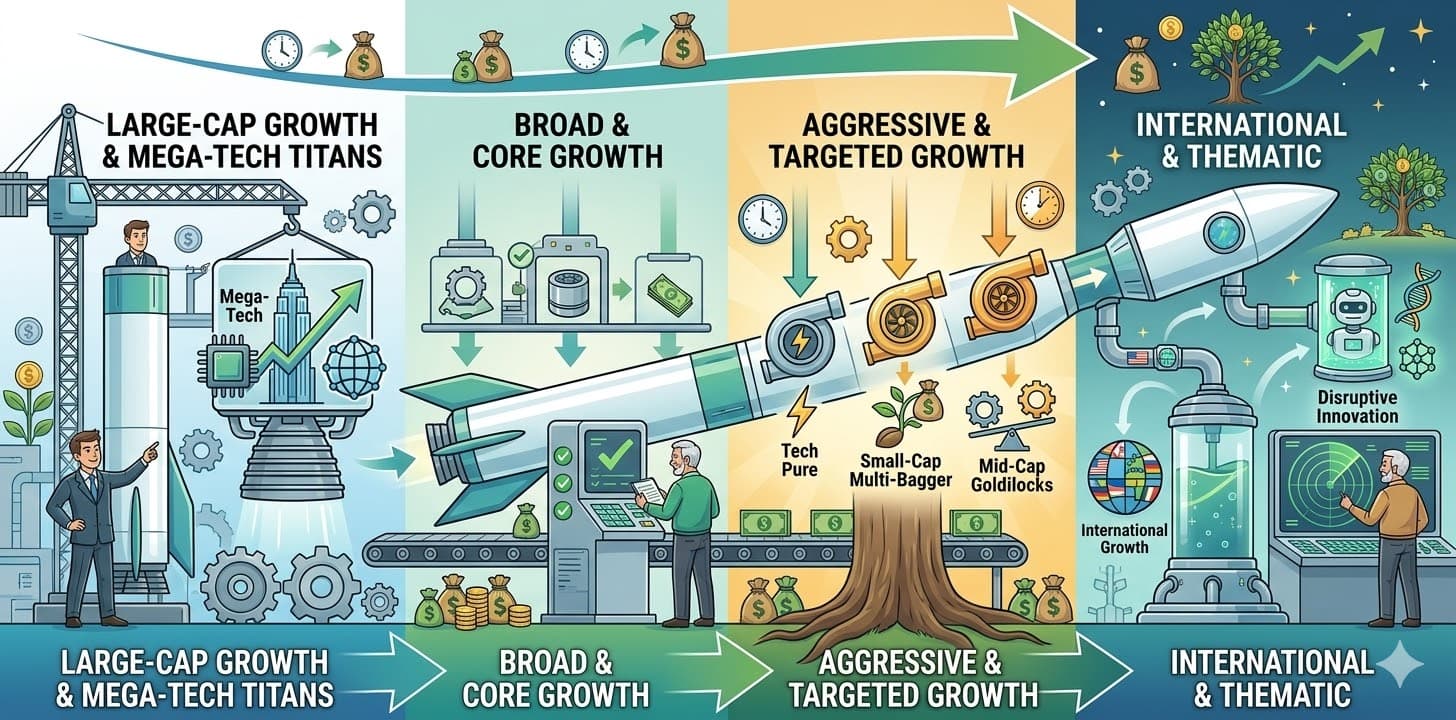
Category 1: The "Big Tech" Titans (Large-Cap Growth)
These funds are the foundation of a modern growth portfolio. They are heavily weighted toward the massive technology and consumer discretionary companies that dominate the US economy. When you hear about "the market hitting new highs," these are usually the funds leading the charge.
1. QQQ - Invesco QQQ Trust
The Strategy: The "Q's" track the Nasdaq-100 Index, which consists of the 100 largest non-financial companies listed on the Nasdaq exchange. By design, this excludes banks and traditional industrial giants, resulting in a portfolio that is unapologetically tech-heavy.
The Benefits: QQQ has arguably been the best performing major index ETF of the 21st century. It gives you concentrated exposure to the global innovators—Apple, Microsoft, NVIDIA, Amazon, and Meta make up a massive percentage of the fund. It is highly liquid and is the standard benchmark for growth performance.
The Drawbacks: Concentration is a double-edged sword. With over 40% of the fund often in just its top 10 holdings, if Big Tech sneezes, QQQ catches a cold. It is significantly more volatile than the S&P 500.
2. VUG - Vanguard Growth ETF
The Strategy: VUG tracks the CRSP US Large Cap Growth Index. Unlike QQQ, which is limited to the Nasdaq exchange, VUG can hold stocks from the NYSE as well (like Visa or MasterCard). It holds roughly 200+ stocks, double that of QQQ.
The Benefits: If QQQ is a concentrated bet, VUG is a diversified one. It offers distinct "Growth at a Reasonable Price" (GARP) characteristics and includes more sectors than just pure tech. With Vanguard’s legendary low expense ratio (0.04%), it’s essentially free to hold.
The Drawbacks: It still correlates very highly with QQQ. While it is more diversified on paper, its performance is still driven by the same top 5-7 mega-cap names.
3. SCHG - Schwab U.S. Large-Cap Growth ETF
The Strategy: Schwab's direct competitor to VUG. It tracks the Dow Jones U.S. Large-Cap Growth Total Stock Market Index. Its screening criteria are slightly different, focusing efficiently on forward-looking growth metrics.
The Benefits: SCHG is often the cheapest option in its class. In recent years, its specific index methodology has slightly edged out VUG in total return, though the difference is often splitting hairs. For Schwab brokerage users, it’s a no-brainer integration.
The Drawbacks: Like VUG, it is top-heavy. Investors looking for "true" diversification might be alarmed to find that nearly 13% of their money is in just one company (often Apple or Microsoft depending on the year).
Category 2: Broad & Core Growth
These funds offer a slightly wider net or a different methodology, making them suitable as standalone "core" holdings for investors who don't want to think too hard about sector allocation.
4. IWF - iShares Russell 1000 Growth ETF
The Strategy: This fund tracks the Russell 1000 Growth Index. The Russell indices are the preferred benchmarks for institutional investors. This fund captures growth stocks from the top 1,000 US companies, dipping slightly further down the market cap scale than the S&P 500.
The Benefits: It’s the "professional's choice." If you want to match the performance of large-cap growth managers, this is the index they are trying to beat. It provides extremely deep liquidity for active traders.
The Drawbacks: The expense ratio is typically higher (around 0.19%) than Vanguard or Schwab equivalents. For a buy-and-hold retail investor, that cost difference compounds over decades.
5. SPYG - SPDR Portfolio S&P 500 Growth ETF
The Strategy: SPYG takes the S&P 500—the 500 most iconic companies in America—and filters for growth characteristics (sales growth, earnings change, and momentum).
The Benefits: "Quality" is the keyword. Because all holdings must be in the S&P 500, they usually meet profitability and viability standards. You avoid the unprofitable, speculative tech companies that sometimes find their way into broader indices.
The Drawbacks: You miss out on the hyper-growth phase of companies like Tesla or Uber before they join the S&P 500. By the time a stock enters SPYG, its most explosive 1000% growth phase might already be over.
Category 3: Aggressive & Targeted Growth
If Large-Cap growth is the engine of a portfolio, these are the turbochargers. They offer higher potential returns but come with significantly higher volatility and drawdown risk.
6. VGT - Vanguard Information Technology ETF
The Strategy: This is a pure sector play. VGT buys essentially every investable IT company in the US. It excludes companies like Google and Meta (which are classified as Communication Services) and Amazon (Consumer Discretionary), focusing purely on hardware and software.
The Benefits: Unadulterated exposure to the digital revolution. If you believe software will continue to eat the world, VGT is the purest way to express that view.
The Drawbacks: It is surprisingly concentrated. Apple and Microsoft alone can make up 40% of this entire fund. It is not diverse. If the tech sector faces regulatory headwinds, VGT has nowhere to hide.
7. VBK - Vanguard Small-Cap Growth ETF
The Strategy: VBK targets small companies with aggressive growth profiles. These are firms with market caps roughly between $300 million and $2 billion.
The Benefits: Small caps are where the "multi-baggers" live. It is mathematically easier for a $1 billion company to double than for a $3 trillion company. VBK gives you exposure to the future giants of America while they are still in their infancy.
The Drawbacks: Volatility. Small-cap growth stocks get absolutely crushed during recessions or periods of rising interest rates. You need an iron stomach and a 10+ year time horizon to hold this fund effectively.
8. VOT - Vanguard Mid-Cap Growth ETF
The Strategy: Targeting the "Goldilocks" zone. VOT invests in mid-sized companies—too big to be small, too small to be giants.
The Benefits: Historically, mid-caps have offered the best risk-adjusted returns in the market. They have the financial stability to survive downturns (unlike small caps) but still have plenty of room to expand (unlike mega caps).
The Drawbacks: They are often the "forgotten" asset class. They don't have the excitement of startups or the safety of blue chips, so investors often underweight them.
Category 4: International & Thematic
The US has dominated growth for 15 years, but ignoring the rest of the world is a risk. And for those who want to swing for the fences, thematic ETFs offer a high-risk path.
9. EFG - iShares MSCI EAFE Growth ETF
The Strategy: EFG targets growth companies in developed markets outside the US and Canada—think Europe, Japan, and Australia.
The Benefits: The world is full of innovators outside Silicon Valley. EFG gives you exposure to luxury giants like LVMH, pharmaceutical leaders like Novo Nordisk, and semiconductor equipment makers like ASML. It is a critical diversification tool if the US dollar weakens.
The Drawbacks: International markets have structurally underperformed the US since 2008. European demographics and slower economic growth have been headwinds that this fund has had to fight against.
10. ARKK - ARK Innovation ETF
The Strategy: An actively managed fund led by Cathie Wood. It focuses on "disruptive innovation"—genomics, blockchain, robotics, and AI. Unlike index funds, the managers actively pick and choose winners.
The Benefits: When it works, it really works. In bull markets fueled by liquidity and hype, ARKK can deliver triple-digit returns in a single year. It offers exposure to cutting-edge ideas that conservative indexes ignore.
The Drawbacks: When it crashes, it crashes hard. Drawdowns of 70% or more are possible. High fees (0.75%) and manager risk make this a "satellite" holding at best, not a core portfolio foundation.
The Counter-Argument: The "Growth Trap"
Before you go all-in on growth, a warning.
Growth stocks derive much of their value from future expected earnings. This makes them highly sensitive to interest rates. When rates rise, the value of that future money decreases, and growth stock valuations compress—fast.
In 2022, while dividend funds held steady, many growth funds dropped 30% or more. The "Growth vs. Value" pendulum swings back and forth over decades. Investing 100% in growth ETFs means you must be willing to endure periods—sometimes lasting years—where your portfolio underperforms boring value stocks.
Just because growth has dominated the last decade doesn't guarantee it will dominate the next. A balanced portfolio usually includes some exposure to Value or Dividend strategies to smooth out the ride.
Conclusion
Building a portfolio with Growth ETFs is about acknowledging a simple truth: optimism pays. Despite wars, recessions, and pandemics, human innovation has consistently driven corporate earnings higher.
For most investors, a "Barbell Strategy" works best. Use a broad, low-cost fund like VUG or SCHG as your portfolio engine. Then, depending on your risk tolerance, sprinkle in VBK for small-cap potential or VGT for concentrated tech exposure.
Remember, the goal of growth investing isn't income today—it's wealth tomorrow. The price of admission is volatility. If you can handle the ups and downs, the destination is usually worth the ride.
Disclaimer: This blog post is for informational and educational purposes only and should not be construed as financial, investment, or tax advice. The financial markets involve risk, and past performance is not indicative of future results. Always conduct your own thorough research and consult with a qualified financial advisor or tax professional before making any investment decisions. The tools and information provided are not a substitute for professional advice tailored to your individual circumstances.
More ETF Comparisons
Explore other side-by-side ETF comparisons popular with dividend investors.