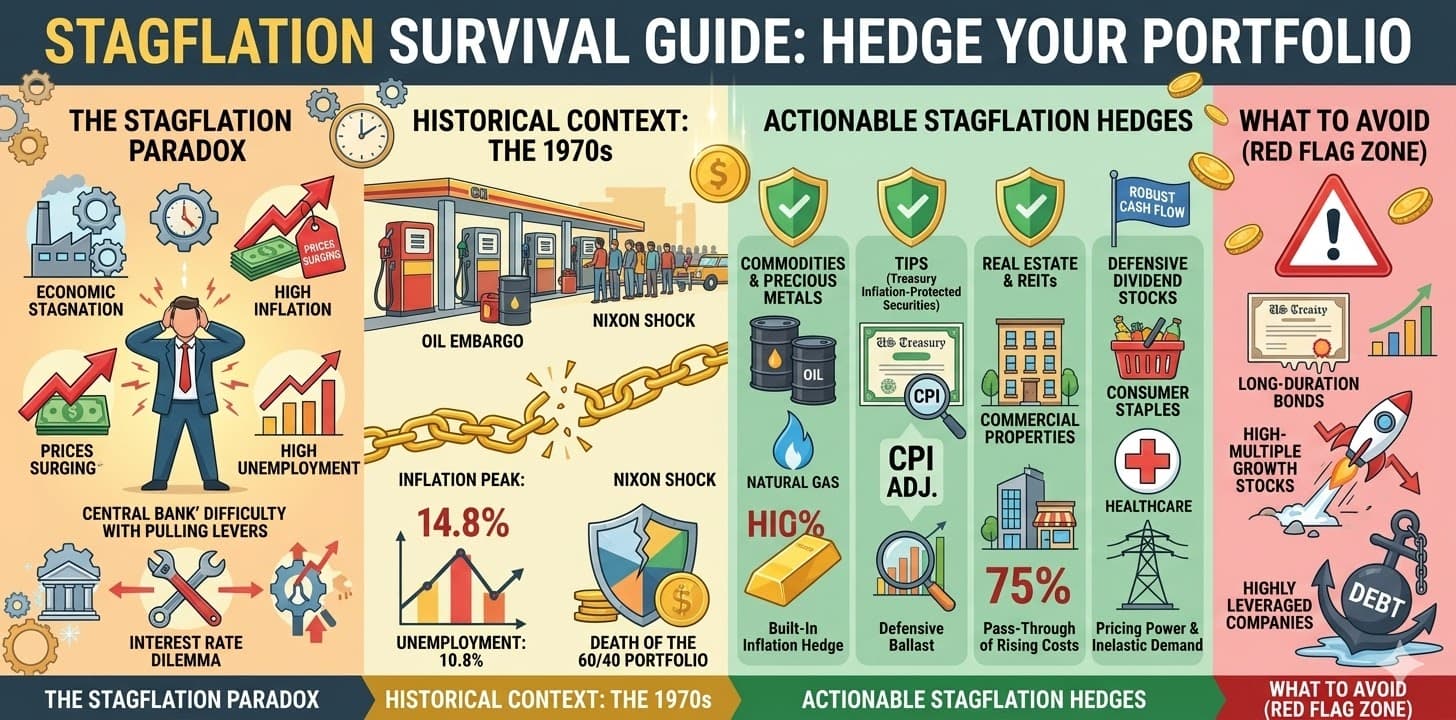
Stagflation is often considered one of the most challenging economic environments for both policymakers and investors. Unlike typical recessions where prices fall, or economic booms where prices rise alongside growth, stagflation presents a paradoxical nightmare: stagnant economic growth combined with high inflation and rising unemployment.
For investors, navigating stagflation requires a fundamental shift in strategy. The traditional portfolios that thrive in standard economic cycles often suffer deep drawdowns. In this guide, we will explore what stagflation is, look at historical examples, and detail actionable strategies to hedge your portfolio against its destructive effects.
What is Stagflation?
The term "stagflation" is a portmanteau of stagnation and inflation. A standard economic cycle usually exhibits an inverse relationship between inflation and unemployment (often visualized by the Phillips Curve). When the economy grows rapidly, unemployment drops, and inflation rises. When the economy shrinks, unemployment rises, and inflation falls.
Stagflation breaks this rule. It is characterized by:
- High Inflation: The persistent loss of purchasing power as prices for goods and services surge.
- Economic Stagnation: Slow or negative Gross Domestic Product (GDP) growth.
- High Unemployment: A tough labor market where jobs are scarce.
This environment is uniquely destructive because the central bank's primary tools are put at odds. If the Federal Reserve lowers interest rates to stimulate growth and create jobs, it risks fueling even higher inflation. If it raises rates to crush inflation, it risks deepening the recession and increasing unemployment.
The 1970s: The Textbook Case of Stagflation
The most prominent historical example of stagflation occurred in the United States during the 1970s. The crisis was triggered by a perfect storm of policy errors and external supply shocks.
In 1971, President Richard Nixon removed the US dollar from the gold standard (the "Nixon Shock") and implemented wage and price controls. Shortly after, the 1973 oil embargo by OPEC caused oil prices to quadruple.
The economic metrics from this era are staggering:
- Inflation: CPI inflation averaged nearly 7% throughout the 1970s, peaking at an agonizing 14.8% in March 1980.
- Unemployment: The unemployment rate spiked to 9% in 1975 and hit 10.8% by 1982.
- Stock Market Performance: US equities delivered weak nominal gains across the decade, and inflation left investors with poor real returns.
During the Great Inflation era, the traditional 60/40 portfolio struggled badly in real terms. Inflation eroded the purchasing power of fixed-rate bond income, while slower growth and repeated recessions pressured corporate earnings and equity valuations.
More recently, the aftermath of the COVID-19 pandemic stirred fears of a new stagflationary episode in 2022. Global supply chain breakdowns and massive fiscal stimulus drove inflation to 40-year highs (headline CPI reached 9.1% year over year in June 2022), while real GDP contracted in the first quarter and recession fears intensified. The economy ultimately did not become a clean repeat of 1970s-style stagflation because unemployment stayed low, but the episode was still a sharp reminder of how quickly stagflationary pressures can emerge.
How to Hedge Against Stagflation
If standard stocks and bonds suffer during stagflation, where should investors hide? The key is to find assets that either act as a built-in inflation hedge or benefit directly from the specific dynamics of rising prices and constrained supply.
1. Commodities and Precious Metals
Commodities—such as oil, natural gas, agricultural products, and industrial metals—are often the root cause of stagflationary supply shocks. Consequently, they tend to be one of the best-performing asset classes during these periods. When the cost of raw materials goes up, owning the raw materials provides a direct hedge.
Gold, in particular, is the classic safe-haven asset. Before President Nixon ended dollar convertibility in 1971, gold was officially priced at $35 an ounce; the market price later surged above $800 an ounce in early 1980.
Gold produces no yield, which is a disadvantage when real interest rates are high. However, during stagflation, inflation often vastly outpaces nominal interest rates, resulting in negative real rates. This dynamic makes gold highly attractive.
2. Treasury Inflation-Protected Securities (TIPS)
Standard fixed-rate bonds are toxic during high inflation because their fixed interest payments lose purchasing power over time. Treasury Inflation-Protected Securities (TIPS) are US government bonds whose principal value is adjusted based on the Consumer Price Index (CPI).
When inflation rises, the principal of a TIPS bond increases, ensuring that the investor's purchasing power is protected. While they won't offer the massive upside of commodities, TIPS provide the ultimate defensive ballast.
3. Real Estate and REITs
Real estate is a tangible, "real" asset with intrinsic value. During inflationary periods, property values and rental rates organically rise, matching or exceeding inflation.
For investors who do not want to purchase physical property, Real Estate Investment Trusts (REITs) offer liquid exposure. Commercial REITs with short-term leases (such as apartment buildings or self-storage) can quickly adjust their rents higher to pass the burden of inflation onto tenants.
4. Defensive Dividend Stocks
While broad market indexes struggle during economic stagnation, not all equities are created equal. High-growth tech companies with valuations based on cash flows decades into the future get crushed by high interest rates.
Instead, investors should pivot toward defensive sectors that possess pricing power and inelastic demand:
- Consumer Staples: People still need to buy groceries, toothpaste, and household goods regardless of the economy.
- Healthcare: Medical treatments and pharmaceuticals are non-negotiable expenses.
- Utilities: Energy and water consumption remains relatively stable, and regulated utilities can often pass cost increases directly to consumers.
Companies in these sectors often pay reliable dividends. Receiving robust cash flow today is much more valuable when inflation is eroding the future value of money.
What to Avoid During Stagflation
Understanding what not to own is just as important as knowing what to buy. During stagflation, avoid:
- Long-Duration Bonds: A 30-year bond paying 3% will be decimated if inflation rises to 8%.
- High-Multiple Growth Stocks: Companies burning cash today for a promise of future profitability suffer when inflation discounting rates spike.
- Highly Leveraged Companies: As central banks hike rates to fight inflation, debt servicing costs explode, pushing heavily indebted companies toward bankruptcy.
The Bottom Line
Stagflation acts as a brutal stress test for investment portfolios, heavily penalizing standard asset allocations. By studying the lessons of the 1970s and tactically reallocating toward tangible assets, commodities, TIPS, and defensive dividend producers, investors can build a resilient portfolio capable of defending purchasing power even in the most hostile macroeconomic environments.
Disclaimer: This blog post is for informational and educational purposes only and should not be construed as financial, investment, or tax advice. The financial markets involve risk, and past performance is not indicative of future results. Always conduct your own thorough research and consult with a qualified financial advisor or tax professional before making any investment decisions. The tools and information provided are not a substitute for professional advice tailored to your individual circumstances.